 Steam
SteamNo numbers here!
I don’t review using a system, or out of five stars. See my thoughts on numerical ratings, if you’re wondering why.

Premise
The sequel to Strange Horticulture! If you followed my recommendation there, then I’d say just go for this one blind. It improves upon every aspect of the first game. A lot of this review is re-hashed from the first game, with some extra notes specifically for Strange Antiquities; so feel free to skip those parts if you have read my review on the first game.
You’re an antiquarian (or, specifically, in in-game lore, a thaumaturge) managing an antiques shop. Customers go in and you have to satisfy requests of varying specificity—sometimes they know what plant they’re looking for, sometimes you’ll have to choose what Object to get them, and sometimes you have to figure out what they need.
Spoiling the game won’t benefit this review, but I’ll mention that there is an overarching story. The story keeps you asking for more, and the content’s breadth keeps it from being monotonous.
Steam Deck playability
Game runs perfectly without issue on the Steam Deck. One important thing to note is that there’s no touchpad functionality. You’ll have to configure that yourself, but it has native generic gamepad compatibility. However, unlike the first game, cursor movement has improved.
There’s an auto-label feature! No more time wasted re-typing stuff that the game already told you in an item’s label. The game tells you about it as soon as you switch to playing with a gamepad, or on Deck.
I unfortunately missed that feature on the first game (since it doesn’t tell you about it), but exhaustively checking the settings is now a mental note the next time I write reviews.
Content after this warning contains minor spoilers.
For those who don’t mind, I’ll talk about stuff that (1) occur very early on in the game and (2) what I deem to be insignificant to the experience as a whole. If enjoying content completely for the first time (i.e. a blind run) is important for you, I advise you to exercise caution.
Mechanics
The game’s core loop is getting a request for an “Object”, and you identifying that Object and fulfilling said request.
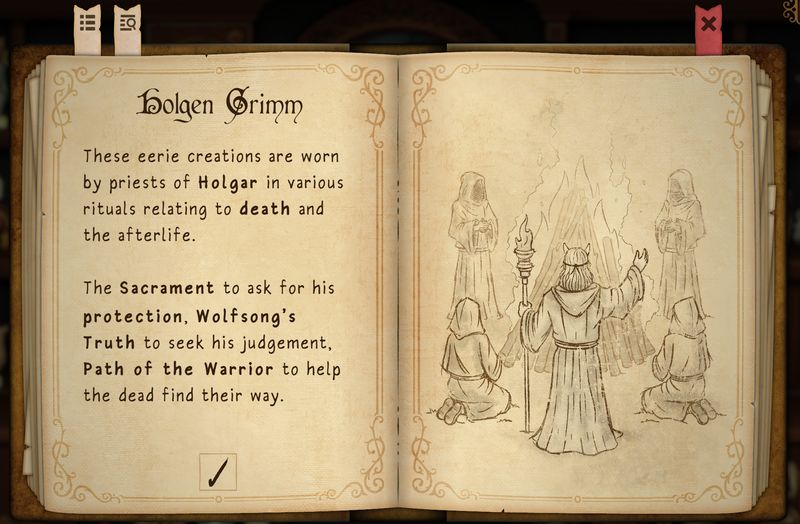
- You will have to rely on incomplete information, such as vague descriptions and possibly helpful illustrations. As an unrelated example, there may be an object named “Carlos’s Foot,” with a foot illustrated on the page—but the actual item is a snail statue (likely because a “foot” also relates to snails), you get the idea. You’re consulting multiple in-game encyclopedias for this.
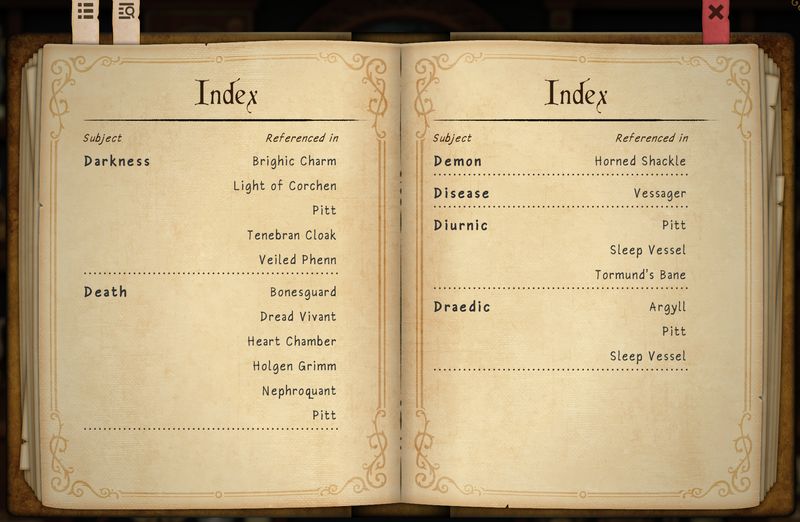
- The game is definitely more difficult than its predecessor. Descriptions are less straightforward and less empirical; and a good number of items reference each other. The game does make this easier for you by putting important details in bold, and including an index of these terms in the main book.
- You get new Objects, or new book entries, or entirely new books, nearly each time you fulfill requests.
- There are other, more complex mechanics I won’t spoil, but the “identifying Objects” part gets harder with increasingly vague descriptions and additional identification mechanics.
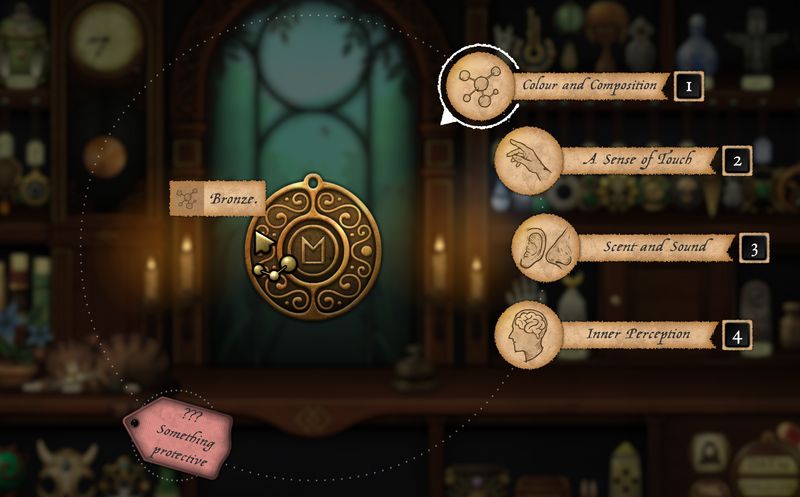
- Strange Antiquities expands on the first game by having a more detailed inspection window of each Object. You can use four different senses when inspecting an item, and can even focus on the smaller parts (e.g. an embedded gemstone, parts of different materials) to look out for differences.
- Moving away from plants and focusing on artifacts gives the developers more flexibility on the design. Again, I’d like to keep spoilers to a minimum, so just put your faith in me when I tell you that the variety on this one has substantially increased.
Feedback mechanic
If you get Objects right, the game rewards you with… more game. If you get Objects wrong, a meter fills up, which does set you back. Unlike the first game, I’ve actually filled up this bar. Best case scenario, you get back to what you’re doing, and I still don’t know the worst case scenario when you do. Again, an exercise left to the reader.
Game length and value
I got an ending after 6.8 hours. Finished this one without hitting the Hints button this time!
I’d say the length is just right. Unlike the usual city-builders and strategy games I play, where length (and quality) of playtime is typically seen as a good thing, dragging out mystery games like these isn’t my cup of tea—unless you have distinct sections and a way to keep things fresh.
I bought the game at full price (565 Php), and I would say the price is just right.
Content and replayability
There is post-game content, and there are multiple endings. If you love the gameplay loop, there’s probably an extra few more hours for you. The content is not randomized so you’ll definitely recognize the Objects on your succeeding playthroughs beyond the first.
Do you need to play the first game?
Straight answer: no. However, you’ll enjoy the callbacks and cameos related to the first game, so I do highly recommend playing Strange Horticulture first.
Pros and cons
The positives
- Much like the first game, Strange Antiquities is not only Lovecraftian, but also crafted with love:
- Each Object is meticulously designed and no two Objects are identical. There’s no lazy palette swapping involved. The Objects are unique enough for you to tell them apart—yet similar enough to induce some confusion when necessary.
- The subtle animations, the sound design of an item when you inspect it aurally, adds to that. Definitely a more polished game.
- The atmosphere is just straight immersive. The music is calming and doesn’t intrude on your thoughts. Sometimes, it also rains in-game, adding to the ambience.
- It does not get boring. The breadth of content is wide enough to fend away dullness, but small enough to combat repetition. There are also callbacks to plants you’ve previously identified, so studying the plants consciously as you go is greatly rewarded.

- There’s enough QoL to keep you going. You can label Objects, reorder them (I ordered them alphabetically for easier access) as you see fit. Random notes and letters you’ve already gone through can also be archived to reduce clutter. Labelling has been improved, where you can customize the color and shape of the label itself, and add a custom icon to each label if you see fit.
- Choices matter. There are multiple, well-thought out endings to the game. Makes it feel you own the story as much as you own your antiques shop.
- I believe this game is playable for the colorblind. May be a bit harder with the gemstone colors, but with the labelling improvement and the better inspection tool, it should be a non-issue.
- An in-game hint button. The hints can be incremental (e.g. two hints, with increasing amounts of information being given away), but not wholly destructive in the sleuthing experience. Very helpful if you get stumped / don’t know what to do.1
- Works great on ultrawide screens. Unlike the first game where it’s forced on 16 (which isn’t a con for most people, hence my omission in the first game’s review), the game plays well even on my 32 screen. Navigation can be done through WASD or via the arrow keys, which makes things easier.
The negatives
- I honestly can’t say anything negative about the game. Everything seems to be in tip-top shape, and I’d be genuinely forcing myself looking for cons about the game. The Overwhelmingly Positive reviews on Steam reflect that, I’d say.
Conclusion
As a whole, it’s a must-play for me! I particularly recommend it to the following:
- Players of the first game! I need not say more.
- Fans of Papers, Please and similar games. You can see the inspiration, but is different in every way. The similarity ends in the “detailed inspection” part. If you wished for a more varied game, and in a Lovecraftian/thaumaturge style, then this will scratch your itch.
- People who seek mystery in games but don’t like gore + jumpscares. Which also includes myself. Sometimes it gets creepy, but not gore-y in any way. There is blood, but only in specks on some Objects.
- People who’d like to try out a mystery game for the first time. I believe the game is very beginner-friendly.
However, I can’t recommend it to:
- People seeking a straight horror / gore experience. This game is just not it.
- Gamers seeking a lengthy, twenty goose chases-long game. The game is very concise and can be done in a day or two by someone with experience.
Go get the game! I got it on Steam for full price here. You can also check out my detailed review of the first game here.
Footnotes
-
Though I recommend that if you do get stumped, just stop playing and come back to it another time. ↩